Archive for the ‘ film ’ Category

the iMAC(s) experience

It could eat my face.

It could eat my face

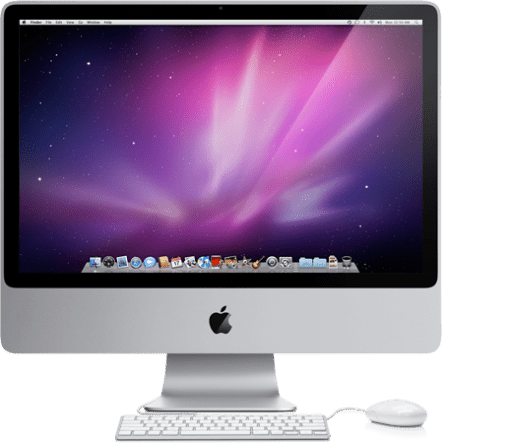
I stared at it for five full minutes before I had the courage to turn it on.  I thought it would eat my face off it was so huge.  My 27″ iMAC.  Wow.

Mom said that it says “I am doing film.”  And finally, I realized that everything I have saved for in my whole life—barring my season of consecration and my piano, which feed my spirit—everything else, has gone into this moment:

I can make movies now!!

I have moving art before me and connected to me.  My body has extended itself into beautiful pieces of metal and plastic, and I can create living moments.  Living moments.  Living.

Amen.

Mon Oncle (Moderne?)

eaten alive by our own designs?

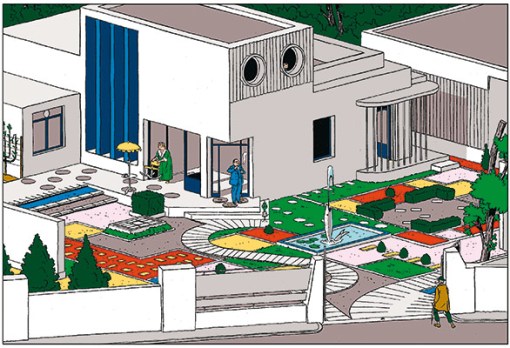
Dans Mon Oncle, nous voyons un homme curieux qui decouvrit que la vie c’est “moderne”. Et, “moderne” n’est pas “bien” tous les temps. Deux terres connaitent et essayer vivre ensemble. Pendant le film, c’est très dole, mais un peu triste parce que les personnages ne voie pas que se passe. L’homme avec un carrière constamment a mal humoraux. Sa maison et très beau mais c’est très géometrique et n’est pas facile chez vivre. L’homme–l’oncle–sans travaille est très heureux. Il apporte heureusement tous les endroits qu’il visite. La famille de la maison moderne est comme la cuisine de la maison : la fontaine, le garage, la cuisinere tout sont dangereux!
The Modern House: living monster?

The Modern House: living monster?

The Modern House, full of all its amenities—which seems quite a scary word that must necessarily be included in an sterile and salesmen-like discussion of appliances—is a threatening place.  Electrocution, hypothermia, and scalding are a very few of the accidents we face in our daily hygienic routine.  In no other era than the sixties, perhaps, we find the looming apocalypse of our own invention encroaching on our sacred spaces.  The places we eat.  The places we undress.  The places we converse.  The places we make love.  They are now filled, as Mon Oncle charmingly demonstrates, with abstract visions of man’s achievements: liberation from organic dependency on our environment.  In the ultimate irony, we have risen above the dirt to be forever enmeshed in electrons.
The Organic House: long live the labyrinth!

The Organic House: long live the labyrinth!

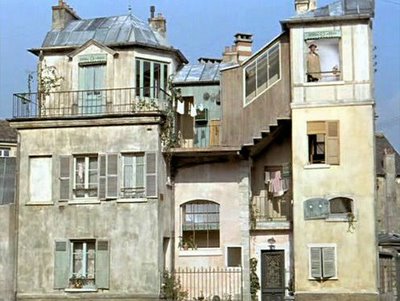
In stark and appealing contrast, we linger on the labyrinth of stairs leading Oncle to the top of his morally superior position.  From his perch at the top of a healthy compost pile of cardboard, rotting planks, fluttering curtains, and shimmering metal, he can even coax a canary to sing.  His knowledge of the elements, the sun reflecting off the glass panel of his perfunctory window shutter, brings things to life.  Rather than leading us through the maze of our own pomp and circumstance, he maneuvers through the versatile manifestations of our globe’s interactions.  No picky pebble walkway for him: just the crumbling brick beneath our feet.

In a glorious moment, Oncle demonstrates his rejection of entropy and simultaneous appreciation of decay by picking up a brick he has knocked off a picturesque pile of rubble.

Long live the organic!  Long live the humorous!  And long live our embrace of life being lived, by-products, inconveniences, and all.
The Psychology of Provision

money makes the world go around, the world go around

money makes the world go around, the world go around

I remember when I learned what money meant.  It wasn’t only dollars and cents; it was divisions and definitions.  Who you are, what you can have, what you can’t have, how you can make a life for yourself–all these things manifested materially.

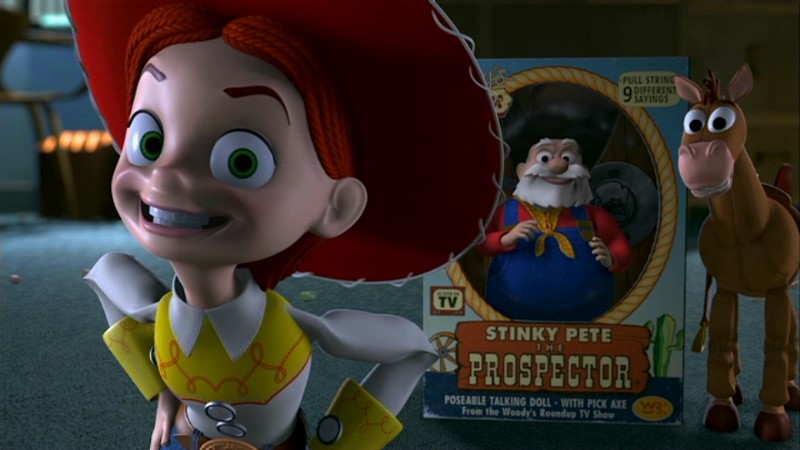
It was Barbie.  In the Walmart toy aisle.  With the red cowgirl outfit.

Mom explains that she was expensive.  Like a Christmas gift.  Suddenly, the $20 on her price tag took on value.  They represented the paper money in Mom’s wallet, the hours Dad was gone during the day working to earn that money, the weeks and months I would have to wait to have her, and the thrill of possession when she was finally mine.  Although the toys have changed, the psychology of provision doesn’t really.

My dad still worries that he can’t provide us enough.  Or he wonders if we are grateful for what we have.  He views life itself as a luxury; we try to problem-solve it.  There is a generational gap, and there is a generational discourse that happens in every penny, every exchange.

Toy Story 3 and its preceding films have picked up on this theme of materialization.  The filmmakers at Pixar understand that the abstract expression such as love, care, attention, protection, etc. are made real through objects.  We need food, shelter, and warmth to survive, of course, but those delicacies of philosophy that make Life happen must be brought to earth.  Plastic and metal and electricity and wood–these mediums often bear its weight.  Toy Story 3 was brave enough to take us to the brink of its destruction: what does the deterioration, the breaking down of our material world say about those immaterial things that it represents?  What does my brother’s decision to upgrade his cell phone and get his own plan say about his relationship with my dad?

J’adore le film Rouge

Valentine et Joseph regardent...

J’adore le film Rogue. C’est un film avec beaucoup d’intéressant connections–entre les autres films de Kieslowski, mais aussi dans ce film. Valentine tombe dans l’amour avec un homme qui est eu un juge. Maintenant, tout ce qu’il fait est écouté. Il écoute conversations de ses voisins. Au début, Valentine pense qu’il est un dommage. Mais, pendant le film, ils ont appris à l’aimer. Mais, cette amour n’est pas sexuelle ; celle était un lien entre deux âmes. Le juge vieux et le juge jeune sont les deux s’entendant a Valentine. Donc était vous vous entendre ?