Archive for the ‘ insights ’ Category

A Halo or Horns? The Playboy Club

Disclaimer: The following post will require that you be willing to engage in adult content, film theory, and iPhone apps.

The slippage of meaning in words is part of what makes it fun to talk.  Think Shakespeare and his irascible puns; think Conan and Colbert and their commentary; think Derrida and differance.  Okay, maybe don’t think about linguistic theory.  Think about sex.  And porn.  And erotica.  And titillation.  Yes, when they are in italics that means the word itself, the letters in a row—not what you’re picturing in your head.

Despite their slipperiness, I’d like to say a few words about how important it is to try to hang on to the distinguishing feature of words: that they really do help us get a grip on reality.  And keeping a grip on reality is really important if you want to have anything to do with it.

The Playboy Club---cultural examination or tantalizing temptation?

The Playboy Club---cultural examination or tantalizing temptation?

This fall, NBC is premiering a new show called The Playboy Club; lots of people are petitioning that NBC refrain from premiering pornography on mainstream network television.  Not a new idea, this petitioning of a network or corporation to refrain from selling or distributing material considered detrimental to society.  It’s at the very heart of American democracy that a lot of names on a piece of paper with lots of words on it has the power to effect change.

But—and here’s the key—the words need to have meaning.  They have to make mutual sense among the parties involved.  And herein is the problem with the above petition, and many others like it, that have identified a perceived threat to society’s health and tried to do something.  Using words to describe, to literally “write in the air,” something that they don’t mean…well, it means nothing.

Ok, so that was a bit of pedantic explanation.  Let’s break it down a bit.

1. The Playboy Club is not porn. It is a drama with lots of sexual content, but it is not porn. Porn is (and I consult the most reliable source on the planet, my iPhone dictionary app): obscene writing, drawings, photographs, or the like, especially those having little or no artistic merit.  And, although I don’t intend to entertain a debate about what qualifies as artistic merit, I can answer the follow-up in line, “What is obscene?” Well, again according to my iPhone, something obscene is causing uncontrolled sexual desire.  It is important to understand and uphold the distinguishing power of words.  One word (porn) indicates content that is designed to arouse and satisfy nothing but sexual desire.  Therefore, it doesn’t apply to a television “drama about a time and place that challenged the existing social mores and transformed American culture forever…[where] all that glitters is not gold.”

2. Furthermore, The Playboy Club is not endorsing porn.  Pornography is primarily a private indulgence—-hidden from view.  The show is examining the life and culture of [un]fulfilled sexual fantasies, which takes place in a specific place: a club.  A club is usually full of people.

Ok, so now that The Playboy Club is off the hook, is it innocent of all the damaging affects to society of which it stands accused?

The Jefferson Memorial----temple to words of liberty and great (ironic) example of "aura"

The Jefferson Memorial----temple to words of liberty and great (ironic) example of "aura"

3. No, The Playboy Club is not innocent of all charges.  By airing a show full of erotic and provocative dialog and imagery, it is tempting the audience to involve in sexual fantasy—and once involved, the viewer will want to realize (fulfill) the fantasy.  Since I spared you linguistic theory earlier, allow me to walk you through some basic film theory:

  • The very act of watching television creates a sense of “aura”–the type of glorification associated with heroes and idols and temples–around the content.  The figures are forever out of reach, ensconced in a beautiful shroud.
  • Human beings are physiologically and psychologically wired to want (1) to bring things closer and (2) to reproduce them—even more so now than in any previous era because of the ethos of immediacy and replication in which we now live and move and have our being.  See re-tweets, web cams, and FaceTime as exhibits A, B, and C in the affirmative evidence.
  • Our natural response, therefore, to something interesting that we see on television is “to pry [the] object from its shell, to destroy its aura [as] the mark of the ‘universal equality of things.'”  So says, Walter Benjamin, who theorized about this stuff back in 1936 when Hollywood glamour was at its height.

4.  Therefore, The Playboy Club does represent a risk for society’s detriment.  We’ve just looked at how we want to actualize what we see onscreen.  Why are there so many annoying commercials for cleaning products?  We see the product, want the product, buy the product, and the producers make more commercials so that we will again see the product, want the product, buy the product, and so forth.  Our first-world wealth and American independence empowers us to feel entitled in just that way.  And the same principle that sells Lysol plays out with dramas that have lots of sexual content.  The more we offer onscreen, the more people want it.

5. But, people are stupid and selfish.  When they want something, they don’t often check to make sure that it has integrity.  Men that want to be surrounded by beautiful women who will do any sexual act they please don’t usually stop to make sure that those women are there by choice.  They don’t often think about the repercussions for their personal relationships.  Women that want to be sexy and beautiful and petted by wealthy men don’t usually stop to make sure that the man will follow through on his promises, that he won’t beat her, and that she can leave when she wants.  And they, too, may never consider the repercussions for their personal relationships.

So, The Playboy Club may not be porn and it may not endorse porn, but its existence as a network television show will surely create a situation in which people will be set up to privately indulge their fantasies.  And the track record of humanity’s stupid and selfish traits indicates that such an indulgence will probably put many, many people at risk for exploitation, victimization, and personal injury–on both sides of the “fourth wall” that we like to think separates us from role playing and reality.  (This is not the show’s intention—otherwise, why would the same producer who brought us Law and Order: SVU be willing to back it?)

iPhone---is it a good things to have the whole world in our hands?

iPhone---is it a good things to have the whole world in our hands?

While the Playboy revolution of the 60s was important for pushing people to recognize themselves as sexual beings (versus the domestic automatons of the 50s), the shame that continues to surround the culture of sex keeps even 2011 sexuality hidden. And that hiddenness that covers the natural human insistence that our dreams come close and replay on loop, that hiddenness more than anything, is what empowers exploitation. It’s not the content itself that’s the threat; it’s our human propensity to reach out and grab hold of it, regardless of the effects of that action. The petition should not be about the “pornography” of The Playboy Club.  It should address the aura of the TV—the way we respond by extending our reach, ripping it out of the cultural conversation, and trying to replicate it in reality, as if we could hold the whole world in our hands.
The Shrew Stops the Sun

Fie, fie, unknit that threatening unkind brow and dart not scornful glances from those eyes to wound thy lord, thy king, thy governor.  It blots thy beauty as frosts do bite the meads, confounds thy fame as thirlwinds shake fair buds, and in no sense is meet or amiable.  A woman moved is like a fountain troubled, muddy, ill-seeming, thick, bereeft of beauty, and while it is so , none so dry or thirsty will deign to sip or touch one drop of it.

Thy husband is thy lord, thy life, thy keeper, thy head, thy sovereign—one that care for thee, and for thy maintenance commits his body to painful labor both by sea and land, to watch the night in storms, the day in cold, whilst thou li’st warm at home, secure and safe; and craves no other tribute at thy hands but love, fair looks, and true obedience: too little payment for so great a debt.  Such duty as the subject owes the prince, even such a woman oweth to her husband, and when she is froward, peevish, sullen, sour, and not obedient to his honest will, what is she but a foul contending rebel and graceless traitor to her loving lord? I am ashamed that women are so simple to offer war where they should kneel for peace, or seek for rule, supremacy, and sway, when they are bound to serve, love, and obey.

Why are our bodies soft and weak and smooth, unapt to toil and trouble in the world, but that our soft conditions and our hearts should well agree with our external parts?  Come, come, you froward and unable worms, my mind hath been as big as one of yours, my heart as great, my reason haply more, to bandy word for word and frown for frown.  But now I see our lances are but straws, our strngth as weak, our weakness past compare, that seeming to be most which we indeed least are.

Then vail your stomachs, for it is no boot, and place your hands below your husband’s foot, in token of which duty, if he please, my hand is ready, may it do him ease.

Watching The Taming of the Shrew this past weekend at the Shakespeare Tavern reminded me how much there is in a word!  The text of Kate’s final speech does seem at once glorious and distasteful to the modern female mind.  But watching it on stage, with the gesture at the speech’s close, it transcends the battle of the sexes and ends for a moment in the kind of sweet reconciliation all humanity craves with itself.

As Kate places her hand palm-down on the stage, gazes up with confidence into her husband’s eye: he melts.  Falling on his knees beside her, he gently, swiftly lifts the hand and kisses it.  With a wink of sarcasm in his eye, he cries: “Why, there’s a wench!” Then, in utmost solemnity, as if like Davy Jones his heart was beating free of its cage and bare to the knife’s edge, he asks: “Come on, and kiss me, Kate.”

And that’s the power of a woman.  That is the bond of love at the heart of our human longings.  To be the weaker in body, and yet the stronger in sway; to be vulnerable and find that vulnerability met with an even greater bending, yielding, rolling over and over as if waves too strong to stand against are reverberating unceasingly from out our simple hearts.

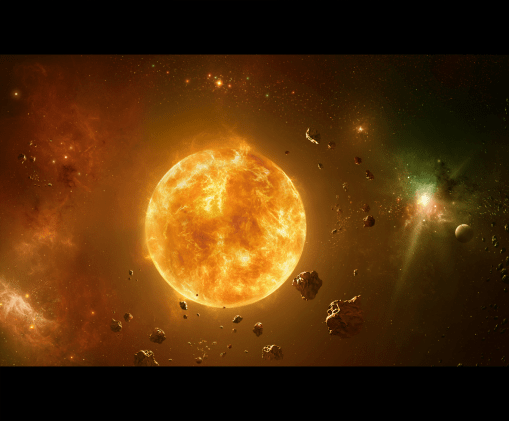
C.S. Lewis has spoken of the “eroticism of obedience.”  I think he hit the mark—the kind of laying down of oneself in awe of something greater.  The beauty of loving is the undulating rhythm of mutual adoration—Kate lays down her hand, Petruchio lifts it; Petruchio lays down his heart, Kate meets its elevated wish.  One of Lewis’ characters described his thought of possessing beauty and fire in  marrying his wife as ridiculous: ridiculous as trying to “buy a sunset by purchasing the field from which you saw it.”  No human can ever be tamed just as the sun can never be purchased for the price of a field.  And yet, the voluntary submission of a living soul to another living soul is powerful enough to stop the sun in the sky.

Swallow_the_Sun_by_synax444

courtesy synax444

For the Love of Red October

There’s a short list of movies that I am always in the mood to watch; at the top is The Hunt for Red October—for all its formulaic glory.  After coming home late from a baseball game last night, my family suggested that we put it in.  Butter-saturated popcorn and IBC root beers in hand, we snuggled down to watch a movie that we can all quote by heart.

Why is that?

The sheer volume of movies produced in the early part of last century and the sheer volume of new series constantly promoted on network and cable TV would imply a need for constant change and stimulation.  On the other hand, most of those movies and series could all be summed up in generic codes: chick flick, action, adventure, thriller, horror, comedy, drama.  (And within those, as Netflix informs me in my “Recommended” tab, there are infinitely finer distinctions, such as critically-acclaimed-strong-female-lead-foreign dramas.)  The formulas have endless variations.

I could contemplate how generic code complies with the human need for uniform variety–whatever the hell that means—or I could simply explain why, of all those possibilities, my family and I continue to return to The Hunt for Red October.  And, as any audience response theorist would champion, I think it comes down to our daily lives, the society in which we live, the questions we face every morning, and the need for reassurance at the end of the day.

It particularly struck me last night that this movie about the Cold War was released one year after the Fall of the Berlin Wall.  It was such a blatant political affirmation of the demise of the U.S.S.R. and the triumph of American ideals: driving from state to state in a pick-up truck.  And yet all its obvious politicizing doesn’t explain why I have loved this movie since I was far too young to even comprehend what politics was.

the mind game of men

the mind game of men

So then I turn to another reason I have often touted: there are no woman in the film (with the notable exceptions of a nagging wife, a precious little girl, and a fuzzy black-and-white image).  During my high school days at the end of a long gab session after gym class, I would relish the total absence of “drama” in The Hunt for Red October.  Women are put forth as the necessary objects of male sentimentality, bravado, and inspiration, but their own feminine weakness and ambiguity is obscured by the rising tides of cool male analysis and straightforward tactical procedure that apparently transcends all political codes or cultural constructions to reach the heights of “universal knowledge.”  Bullshit.  It would be a delightful exercise to argue why women are at the center of an almost entirely male movie, but I’ll leave that to another day of academic pursuits.  Suffice it to say, that female role models or a safe haven from femininity’s worser aspects do not justify my unwavering devotion to Captain Ramius and Bart Mancuso.

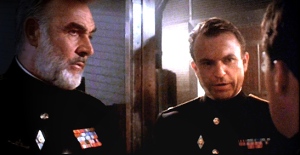
I am, I confess, I little starstruck.  For all my neglect of female considerations, perhaps that is the one inexorable aspect which I must concede: Sean Connery is damn attractive.  As an object of feminine fancy and masculine aspirations, he fits the bill.  But how can a seventy-year-old actor could hold my fifty-year-old father and my fifteen-year-old sister equally spellbound is a puzzle worth solving.  And, therein, I believe is my answer to our love for Red October.

Our lives are hard.  My dad works every day to bring money home for our family.  My sister works everyday to prepare herself for the eventuality that she, too, will one day work to bring home money for herself.  And I work everyday to graduate from dependency to independence.  We don’t complain–and are actually very grateful to ourselves for the effort and our bosses for their monetary acknowledgement of that effort–but a working life is damn difficult.  The stakes are high because our world is no longer tied to the simplicity of growing your own food, making your own clothes, and building your own house—for which I am also grateful.  But the intricacies of our modern economies make us increasingly dependent on what is left over when our hands are tied: our brain.

a submarine: the ultimate metaphor of modernity

a submarine: the ultimate metaphor of modernity

And that’s why at the end of any given day of the week, we will all sit down to watch The Hunt for Red October.  It is a story of men who live or die by their minds.  Their hands are tied.  They cannot support or release their emotions by a punch to jaw or a swift flight down an alley.  They must wait.  In many days of silence, in tiny cubicles of living space, under the watery weight of a world in which they can no longer fight for survival alongside the  other organic bodies.  Enclosed a metallurgical casket of sorts, dead bodies and living minds, they must maneuver complicated man-made mechanisms, both real and imagined, in order to resurrect themselves on shore after the long voyage.  They are never given all the information they need.  They are never given leisure to research or contrive other options.  They are never given the full support of the citizenship they have inherited from the hundreds of generations trying to carve civilization out of a spinning planetary orb.  They are alone in the battle, friend or foe for the taking.

Now, that was rather prosaic of me, but I think my case is born out in the characters of Marko Ramius and Bart Mancuso.  Two men given enormous responsibility and an incredible dearth of resource.  Each moment is a crisis decision: murdering the political officer, breaking contact with the fleet, fleeing to a dangerous canyon, tracking a silent sub, breaking off to pick up an analyst crazy enough to jump out of a helicopter in a storm to get aboard, starting a conversation with the man you are ordered to kill, sending one ping and one ping only please.  Now, of course, one could argue that’s just their job, that if you get involved in the military, that’s what you get.

But I think the  understated performances of Sean Connery and Scott Glenn reinforce the idea that this is normal life.  There is nothing epic about humanity trying to survive.  In a poignant irony, the things that thrill our inner selves—the Montana homestead, the pick-up truck, and the fishing pole—are silenced and displaced so that we can actually retain our lives.  And how many times does every working person do this to themselves every day?  How often must I not read or write or travel or make love or sing or dance or garden or paint or cook because I have to work.  Or not even work, but preserve my opportunity to work.  Preserve my right to work. Preserve my ability to work.

The complex economy and politics we have constructed to accelerate our wealth, productivity, and power may have come at the cost of our own selves—at least our bodies and souls.  This thought, again, is nothing new; hundreds and thousands of other people have chafed under “modernity.”  But just because it isn’t a new thought doesn’t mean I am already comforted.  And watching The Hunt for Red October is comforting.  Because I face this true cost of living every day, it is comforting to see men facing crisis decisions with little or nothing to offer, take a gamble, and come out on the other side—no thanks to the strong arms of the world powers.  Perhaps it is an American political ideal to nurture the hope of the individual in the face of everything else; perhaps it is a school-girl crush to take refuge in masculine prowess; and perhaps it is unrealistic to feed on impossible probabilities.

But feed I must or my heart will fail.

Aiming at Ourselves

Wild Target was a refreshing exercise in forms; it’s almost like a comic strip or animated feature made entirely out of character sketches.  But what’s so marvelous about it, is that, like a Scott McCloud insists, the lack of solid identity on the part of the character creates just the right space for us to insert ourselves into the story.

Somehow these people never look cool, but their inelegance is quite charming.

Somehow these people never look cool, but their inelegance is quite charming.

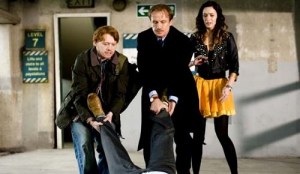
So, in conversation with my friends, I’ve been summarizing the film like this: a middle-aged hit man falls in love with his kleptomaniac target who has soured a deal with a vicious art collector played to a tease by Rupert Everett.  And the guy from Hitchhiker’s Guide to the Galaxy plays the second hit man hired to finish the job; he has unnaturally big bright teeth which I suspect of being false.  Oh, and the first hit man’s mother gets involved to save the family honor—wielding a Hitchcockian knife, no less.  Ta-da!

What makes the film so delightful is its abruptness and its total lack of commitment to its own story.  It rather unceremoniously unwinds with no rush, no hurry—peppered with a little action to keep the flavors nice.  Its rather like a lovely stew set to simmer for hours, marinating in its own premise; stir occasionally to make sure it doesn’t stick to the pan.

At first I felt as if the film had no idea what it was doing.  It kept cutting into the scenes at the wrong moments—for example, it cuts from a “love scene” involving foot massage to a knife crashing down into the pillow beside the “heroine”‘s head.  No creepy lead time, with the creaking of the door and stealthy approach the angelic sleeper.  Just BAM!  But therein lies the joke: watching an eighty-year-old woman ride her scooter into her old bedroom in which a young house guest is in quiet repose just doesn’t quite seem as funny until after that eighty-year-old woman has attacked the young house guest.  The whole film plays out this way, the punch line before the joke almost.

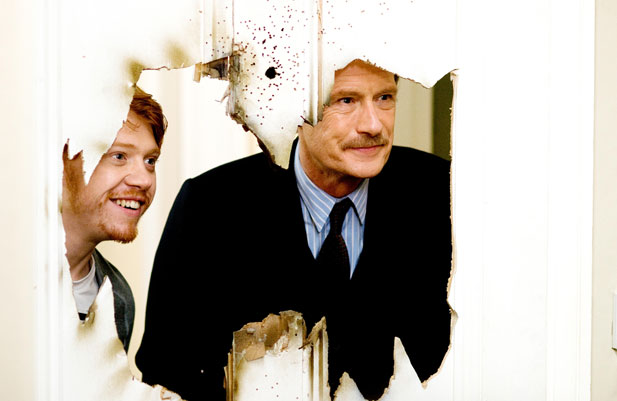
Yes, we are knocking at a door with a big hole in it, because we're polite.

Yes, we are knocking at a door with a big hole in it, because we're polite.

And somehow, as it jumps through the hoops—falling in love by watching the heroine from afar, turning the tables in a gun fight, whisking her away to a hotel room for safety’s sake, the utter opposition of their ways of life, her abandonment of their plan at its most necessary hour, the reunion and coming to terms, her clumsy expression of affection, his utter inability to comprehend “love,” and the ultimate test of their newfound romance—somehow as it jumps through all those hoops that make up the formulaic chick-flick, it rises above it.  Like an out-of-body experience, it joins you in the heavens and looks down on the pathetic three-act play, passes you the popcorn, and says, “It’s that cute?”  And it is.

It is cute.  It is cute because it knows that aiming for the human heart is aiming at a wild target.  And no movie, however great, should ever suppose itself capable of actually embodying all the crazy vicissitudes and epiphanies of a real person.  And because Wild Target embraces that fact and chuckles to itself, you chuckle to yourself, too.  And somehow the epic grandeur of “romantic ideals” become a little less heavy to bear and the mundaneness of your own life seems to be just fine and dandy—because, of course, there is nothing mundane about being a person with fears and loves, wounds and regrets, insecurities and heroic impulses all bound up in a single bodily form.

18 Augusts R.I.P.

Should I be surprised that after 18 years of resuming classes in August (or September, if you count the post-Labor Day glory of elementary school) I am going through withdrawals?

Long live classic Lisa Frank!

Long live classic Lisa Frank!

No more trips to Walmart, Office Depot, Staples, or Target for coordinating folders, fresh college-ruled notebook paper, or superfluous protractors.  No more nervous filling out of agendas, mapping of the hallways, practicing of the lock combination, or ironing of the uniform.  Actually, I’m not sure if I ever ironed my high school uniform… No more midnight run to Walmart (well, 10 p.m. run for the first few semesters until the 24/7 one opened up the road) for plastic martini glasses, lined / un-lined index cards, or polka-dotted set of rain boots and umbrella.  No more calculating the commute (car + bus + walk), downloading the pre-class iPod playlist, impulsively purchasing of the overpriced wall poster, or stalking professors online profiles at ratemyprofessors.com.  Actually, I’ve never done preliminary research on a professor… In homage to my years of education, may 1992 – 2010 rest in peace, I offer an unusual reminiscence: my scholastic pet peeves.  Anyone can write about what everyone else does during school; so I will regale you with what nobody did…but me.

  • All the pages in a coloring book must be finished before a new coloring book can begin; this goes for to-do lists as well.
  • Pencils without erasers are not permitted.
  • Even if I know the teacher will never get to the part where the compass and protractor are required, you must faithfully carry them within easy reach in the pencil pouch at the front of the binder.
  • My book bag must be able to stand on its own four feet.  Literally: no slouching.
  • Gum is ABSOLUTELY required at all times—-no fruity flavors, only mint.
  • Take the prettiest, not shortest, route along the road, bus, or sidewalk.
  • Swing your umbrella in circles as you walk back from class, paying no attention until *SMACK* it hits you in the face.  Repeat.
  • Wear jeans as often as possible so you don’t have to shave your legs.
  • (1) August – September: full make-up and accessories (2) October – November: no make-up, one bracelet (3) December: please shower!
  • All doodling must be worthy of display in the High Museum of Art.  If it’s not, throw it away; stop doodling and pay attention.
  • Take notes—even if you already know the content.
  • Talk to the teacher and answer questions: always.
  • Stay after class to discuss the deeper implications and your own experiences and reactions: always.
  • Stop by whether it’s office hours or not: always.
  • Sleep in class: never.
  • Keep all textbooks—even if you already have a copy of that novel.
O! Education, long may you live on in the hearts of your Students, never ceasing to say: get a life! =)
And now, Ladies & Gentlemen, for your viewing pleasure:
.
.
.

I Shouldn’t’ve Been Surprised

But painting is a SKILL.

I set out today to express my feelings on canvas.  Like any amateur painter, I was convinced that it wasn’t as hard as it looked.  All those people that dreaded arts&crafts class just weren’t following the directions carefully enough.  Red + blue = purple, and any color under the rainbow can be made using the primary three….right?

Palette knife in hand, I approach my landscape canvas, drop cloth strewn haphazardly below my easel.  (Drop clothes, too, were for dummies—-the only reason paint gets everywhere is a. you do something stupid or b. you do something stupid on purpose, in which case you should get a huge studio and plenty of Goodwill clothes like Jackson Pollock.)  I lived to regret both the palette knife and the haphazard drop cloth.

Apparently colors can be active and passive---without your help.

Apparently colors can be active and passive---without your help.

The first flesh tone I designed (yes, I used that pretentious word) was fairly successful.  The person looked, as I’d hoped, sickly and a little yellow.  Yay for me: not only could I paint a person that matched my skin color, but I could do it “expressfully”—implying emotion and grandeur beyond the frame.  Yeah, whatever.  When I tried to do some shading to provide depth of perspective, I royally screwed up.  How the hell do you make a “darker” flesh tone that implies shadow, not an entirely different ethnicity?  Crap, I’m in over my head.

I start mixing and mixing and mixing and mixing.  Now I have every painter’s nightmare: that non-descript, totally ugly gray-imposter that you get when there’s a little of EVERY color you purchased fighting to make something of itself in the goop thats now overflowing the neat little rims of your $5 plastic palette.  Shit.

Finally, I give up and mix it on the canvas (I’m a fan of texture anyway).

A few hours and a few hail Marys later, I’ve got an abstract, multimedia piece—complete with water drips down the canvas and some left over crepe paper from last year’s birthday party cockeyed pretentiously across the muddy color fields.  Damn, if I could only come up with some deep and meaningful title like “No. 432,” I could really go somewhere with this.  I wonder: does eBay have a fine art section?  Maybe I could at least get back the cost of paint…all the gallons and gallons I’m now pouring down my sink, trying to avoid getting yelled at for running up the water bill.

Oh, yeah.  And I dripped right beside the drop cloth, and my clean white carpet becomes the casualty of my self-expression.

Just another lovely Saturday afternoon as an inspired young professional coming to terms with the vicissitudes of modern life.  (Click here to see.)


Soft Lays the Night

Soft lays the night on my beating heart.

Not one, but two things have I spoken.

Don’t forget to turn in your key

when you pack up your things and sashay  away with a crisp apple between your teeth

the last fruit of a weary yoke.


I remembered you at the dawn.

When the mists rolled in through the asphalt cracks and the brakes tore through the treads.

I was there.

I was there when you cried and shuffled to the three-step dirge.

Don’t look away now, in the soft of the night,

in the pillow of the patterned fall.


I will be there again in the blazing 1 p.m. sliding the card in the slot.

Quiet laps the evening on the memories of my mind,

On the tired places that cannot pull together but lie naked, beating at the surface.


Sleep in peace, and pass on to the Time, my wild-hearted friend.


Soft Lays the Night


The Sound of Toil

A fine romance

A fine romance

The Sound of Music is one of those inexorable movies that you either love or hate—-and it may change by the moment.  But the other night when I watched it with my sisters, I was “twitterpated” with it again!  And, like sweet-and-salty snacks, it’s a delicious contrast with another Best Picture winner, Chicago.

The 1965 winner is full of deceptively light-sounding songs about the savvy and perseverance required in an age when noble men lived in sprawling villas raising brilliant children and charming lovely ladies on the ballroom floor.  Seems like an era that didn’t need much perseverance, doesn’t it.  But what I appreciated about The Sound of Music this time was the fact that underneath all the bubbly childish cheer, there is a darker side of a vanishing life.  The house is empty and shadows when Maria arrives.  The children’s uniforms don’t quite fit correctly.  There are no groundskeepers, although the startling view of the lake never alters.  The gala ballroom is full of characters we don’t know, and horses and motorcars vie for the gravel drive.  The story is intimate, but in its intimacy it is also empty—foreshadowing the stripping and rending to come.  Examining Maria’s bedroom during “My Favorite Things,” it struck me that she and the children would have little to take when they ran away: the rooms were like guest rooms, nothing personal, simply accommodating.

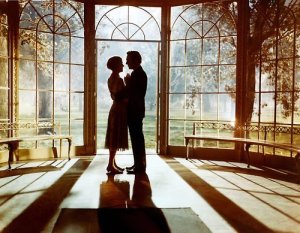
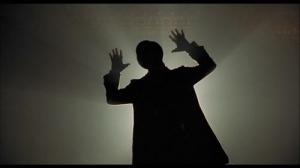
Could this be your silhouette?

Could this be your silhouette?

But in the midst of a broken rhythm of Disappearing, The Sound of Music is wildly romantic and sexy in a soft and subtle way that Chicago countermands.  The sexiness of The Sound of Music is its concrete link to where sexiness came from: child-bearing.  No, of course, child-bearing doesn’t present well on-screen as an erotic and inspiring moment, but the love-bond between a husband and wife is quite literally manifested in their children.  What makes Maria and Georg’s bond so wonderful is that they love each other so well, especially through their tenderness with The Children, despite the fact that The Children are not Theirs.  It’s the ultimate love story—for the same irrefutable reason that movies as hilarious and quirky as Yours, Mine, and Ours and Cheaper By the Dozen have a timeless effect: real love bears fruit.

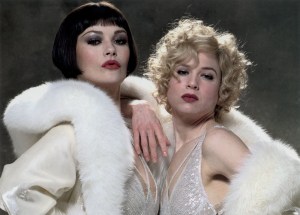
Chicago, on the other hand, depicts the empty eroticism of love disjoined from materiality.  Like a strip tease act, it struts upon its stage promising a lot but delivering little—or, when the moment of delivery comes, its rather disappointing and we wish the mystery were still there.

The world of Austria in the ’30s may have required perseverance of a political nature (which political scene creates a lovely tableau for Maria to demonstrate her new role as Georg’s wife, not simply his governess); but the Chicago of the ’20s is the kind of perseverance that doesn’t ennoble humanity but rather betrays it.  In Roxie and Velma we meet women who we wish could have the luxury of love but for whom we know there is no hope if they don’t reject sincere feeling.  Their lives are too damn hard to actually be experienced full-body.

What are you gonna do about it?

What are you gonna do about it?

Yes, Chicago is dazzling and titillating and it makes you want to watch more, but it ultimately dies away at the end, dissipating into a vapor, a remembrance of hard days and harder nights.

Now for the kicker: while reading Anton Chekov’s short story “On Official Business,” I was struck by the following lines:

And [the magistrate] felt that [the insurance agent]’s suicide and the peasant’s misery lay on his conscience, too; to be reconciled to the fact that these people, submitting to their fate, shouldered all that was darkest and most burdensome in life—how terrible that was!  To be reconciled to this, and to wish for oneself a bright and active life among happy, contented people, and constantly to dream of such a life, that meant dreaming of new suicides of men crushed by toil and care, or of weak, forgotten men of whom people only talk sometimes at supper with vexation or sneers, but to whom no help is offered.  And again: “We go on, go on, go on…”

the anxiety of our age

the anxiety of our age

Could it be that The Sound of Music is only possible because of Chicago?  And what I mean, I suppose, when I say that is really: does the rare, high life floating up near Plato’s Ideal Forms and religion’s noblest creeds depend on a substrate of broken lives and wasted toil?  Can Captain Von Trapp play his suit because Amos pays $2000 to be upstandin’?  Is it as devastatingly simple as the fact that raising seven children is terribly expensive, and, of course you can fall in love if you can afford a governess, but God help you if you’re in so deep you invent a child to save your neck from the noose?  Volcanic soil is the richest for harvest, so scientists say…but does anyone ever consider that the ingredients of finer living (organic food, anyone?) come from much accumulated pressure and toil underneath our floor?  Is one man’s ceiling another man’s staircase to paradise?

The injustice of this must topple in the End.

Continuity = Human

Every now and then there are moments in which you discover a truth.  Survival of the soul depends on such moments occurring frequently—-and yet, their rarity adds to their inexpressible quality sometimes.

About two weeks ago I opened a book that had arrived in the mail for my mother.  (With her consent, of course.)  I don’t remember the title well enough to quote it to you, but it is the primary book describing the Suzuki method for musical training.  (My sister started piano lessons again.)

I flipped through the pages, and, like most people who love to read, I began reading without even knowing where I was reading and why.  But what I read startled me and literally changed my life.  (A timely word is life to the soul indeed.)

Doing something three times amounts to nothing; it is through doing it continuously that anything is finally achieved.

That’s my own paraphrase, but I know I’ve got the most important word right: continuously.  It is the action of continuing that makes life as great as it is.  A continuing, a continuity, a continuum.  All the connections, the sinews, between one second and the next.  Our decisions dwell in the seconds, in the gaps between.  We live in Scott McCloud’s “gutter”—the space between the panels in the comic strip of our sequential activity.

The power of life is in the continuing of it.

And so, each moment now, I choose.  I continue.  I live.

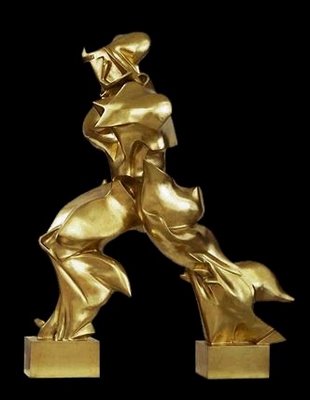
Unique Forms of Continuity in Space (Umberto Boccioni, 1913) = HUMANS

Unique Forms of Continuity in Space (Umberto Boccioni, 1913) = HUMANS

What Driving Does to You

I wonder what driving is doing to my brain and my personality.
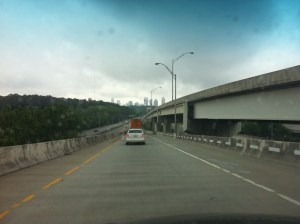
Have you ever thought about that?  There has to be some material effect of the fact that I spend 21 hours a week in my car.  Here’s a few contemplations for consideration:

  • Your car is always traveling forward in a “straight” line, rarely backwards.  There is no “give” or “flexibility” in a steel frame.  Does this make us feel like hamsters in a wheel?  Running and running and never actually moving?
  • We have to stay between the lines, but we enjoy crossing them.  Weaving through traffic is so fun!  But it’s dangerous—both to the body and to the wallet and legal record.  Does this make me feel like a criminal on the run all the time?  Wanting the security that conformity brings but feeling stifled and “unreformed” in my relationship to my surroundings—yearning to be “free”?

    structures, barriers, lines, cities

    structures, barriers, lines, cities

  • There is always threat of violence.  Some idiot could come out of Nowhere and kill you.  There are no guarantees on the road: we are driving towards each other: two parallel lines.  By definition they don’t ever intersect, but can you always draw a straight line, even on a piece of paper? Does this constant imminent danger increase our adrenaline?  Stress us out?  Change our view of people?  We always have to be on the offensive or the defensive.  There is nothing collaborative about driving—-even yielding is seen as a failure to bully your way through.
  • You can’t legally multi-task (or drive barefoot, by the way), but a commute is seen as a waste of time…so you feel compelled to eat in the car, make phone calls, check emails, listen to music, play stupid road games, read billboards, etc, etc, etc.  Therefore, are we in constant internal tension?  And—the more appropriate question—is that the tension that wears us out so that we are so tired that we fall asleep at the wheel, swerve, and otherwise wreak havoc in our multi-ton vehicles?
  • A car is a sacred space, the ultimate personal bubble.  It insulates us from the world around us—which is going by so fast that if we reached out to touch it, it would tear us apart.  How does that affect our willingness to connect with our fellow man?  For example: Pedestrians (humans) become an inconvenient interruption to our linear progression, a source of anxiety because of the threat of bodily (flesh or fiberglass) harm, and an Other who exists in a world we cannot touch.
just keep speeding, just keep speeding

just keep speeding, just keep speeding

Well.  Perhaps my 45 minute commute is getting to me.  Too much time to think.

But then again…is that all it’s doing to me?