12 frames is all it takes

I’m incessantly puzzling over how to depict the exploitation of women without actually re-exploiting them “for the cause.”  How truly does an overly sexualized teenager staring vulnerably into the camera challenge our myths and presuppositions about trafficking in children?  Or how do eroticized action films confront our fantasies and pigeon-hole estimations of femininity?  And then, how do you actually create images of exploitative situations without exploiting the [child] actors involved?

It’s a theme I’ve been contemplating for years now, and my thoughts are in such constant flux and evaluation that I rarely get to actually put “pen to paper” about it.  But today I watched The Click Five and MTV Exit’s new music video for their song “Don’t Let Me Go” and in a flash of brilliance at least one rhetorical construct made sense: twelve frames is all it takes.

Between 2:54 and 2:55 there is a grainy black-and-white flash that says everything: a man pins down and straddles a young girl on a stark white mattress.  The high angle and visual quality of the shot evoke those creepy, voyeuristic hotel security cameras.  Suddenly, in perhaps 12 frames or less, we the viewer are skyrocketed into the bird’s eye view, the simple, clear, gray-scale truth that children are being hurt at the hands of adults who are supposed to protect them.

And it hit my gut.  A four-minute video with pretty tame, allegorical representations of trafficking—and one freezing moment, blink and its gone but forever imprinted on your soul.  For all the complex planning and production and analysis that litters the table of abolition rhetoric, twelve frames was all it took.

Arrested Development (1)

Somehow I missed one of the greatest shows EVER until this week: I just discovered Arrested Development (thanks to my super-brilliant friends who knew it was a match made in heaven).

http://www.youtube.com/watch?v=LBWZdYVeMjw

Not only do I love Jason Bateman (please please at least see Juno and Mr. Magorium’s Wonder Emporium) but I love TV that asks us to take a good long look at ourselves, individually and corporately.  Implied in the long look is the need for action—some kind of decisive maneuver that either confirms, denies, or changes what we see.

Perhaps it’s too simplistic to look at the Bluth family as a representation of America itself.  I’m sure hundreds of other critics who happily discovered this show before I did have made the correlation.  But as the saying goes, there’s a reason that cliches become cliches.  So, bear with me as I assert  that the Bluth family is in some respect America itself.  Broken, dysfunctional, wealthy, lacking integrity, confused, passionate, maybe even philanthropic at turns—-but basically, it’s a family.  Family is not the kind of thing that you can choose to be a part of, but it does have the “opt in” / “opt out” selection at the bottom of the form.  The world itself conspires to set you in the damn thing: whether it’s the biology that makes you happen because of your parents; whether it’s the complex social psychology that makes you a part of a group that comes together and stays together to help each of its members make its way in the world; or whether it’s the deeply spiritual transaction that suddenly binds you to everyone else on the planet that’s as crazy as you.  You don’t “pick” your family but you decide to participate.

Michael Bluth: Remind me why I'm doing this?

Michael Bluth: Remind me why I'm doing this?

Michael Bluth decides to participate.  And that single action makes him a hero.  In a larger sense, those of us that decide to participate in this (ready for another worn out cliche?) melting pot country are heroes.  Nothing about America should work; but it does.  Limpingly, grotesquely, obliquely, embarrassingly, it does.  The Bluth family survives crisis although we’d really all prefer to see them degraded a bit—but not really, because, of course, there’s a lot a bit of ourselves staring back at us.  The American “family” survives crisis although we’d really all prefer to see us cut down to size a bit—but not really because, of course, we are America.  Maybe that’s what’s so damn heroic about MIchael Bluth: he humbly decides to participate in something that’s obviously a poor reflection on himself for the benefit of all the other people caught up in the mess.

Disclaimer: I’ve only seen three episodes.  My opinions are subject to wild and inconsistent changes—-though I usually pick one interpretation and stick with it.

Brains or Brawn?

What a bum deal: Brains or Brawn.  Why does it always have to have the “or” in it?  Why can’t it be both?

my current brain food: Naked Economics, by Charles Wheelan

my current brain food: Naked Economics, by Charles Wheelan

Life example #1 (and the only, since it’s the inspiration for this impetuous post):

I started exercising again this week.  As you may be aware from previous posts, I have a rather tumultuous (yet intriguing and inspiring) relationship with exercise.  I love it; and I loathe it.  It costs me too much.  Most of all, it costs me time.  So, here I stand again: the hour I spent exercising (and the time it takes to shower after, etc, etc) meant that by this evening, I hadn’t blogged yet as planned by my inquisitive Brain.  And my Brawn is sore from a few too many ambitious arrangements with the Bow Flex resistance system.

So, like all good bloggers who are simply sticking to their guns and refusing to be silent even if it means picking something stupid and personal to post about, I decided to rant a little bit about the injustice of the dichotomy, Brains + Brawn.

Bow Flex is sexist: this is the only picture of a woman I found on Google

Bow Flex is sexist: this is the only picture of a woman I found on Google

They both feed each other, Brains and Brawn.  Like a kiss and a squeeze, you can’t have one without the other.  Endorphins make you happy enough to face the abstract world of speculative thought.  And thinking about something More than yourself makes it worth living every moment to the fullest—-even in the dial-pocked face of the treadmill.  So why always the give and take?  Isn’t there enough space in 24 hours for both B&B to get their quality time with you?

Apparently not.

They are too demanding.

So, who do YOU love most?

$ensorship

the MPAA avatar

the MPAA avatar

oyster and pearl

oyster and pearl

The rating system of the Motion Pictures Association of America is far above us. They have discovered the ultimate avatar: the Normal American Parent. Under the guise of this avatar, they crop and edit and cut their way through the discourse of the nation to ensure happy, healthy citizens of us all.


Yes, the MPAA shows up on every preview.

Yes, the MPAA shows up on every preview.

This is the bleak (albeit accurate) view of the MPAA and its role in our film culture presented in This Film is Not Yet Rated. Every film that makes it to theatrical audiences must run the gamut of secret voting procedures, obscure objections, blind cuts, and precedent-less appeals. No other organization in the United States (barring our inestimable CIA) could skip away with such egregious power-mongering. While watching it, I became extremely jealous and proud of my college education, in which professors broke through the money-making studio system to bring me films that challenged my perspectives on life, the Universe, and everything. And, while I sat and pondered the truth that money really does make the world go ’round, the world go ’round, and that if there’s money, someone has to stick their hand in it to control the current, I also became increasingly bewildered at the underlying tug-of-war between the Faith and Knowledge.


Faith and Knowledge---Life or Death?

Faith and Knowledge---Life or Death?

You see, two clergymen serve on the appeals board of the MPAA film ratings committee. Whether voting members of passive observers (even former committee members couldn’t tell which), their presence harkens back to the long struggle in the church (and America, as a larger encasement of said Church) over the issue of discourse. Should everyone have access to all the knowledge they want?—If yes, ’tis a ‘yes’ sprung from the glorious expectation that knowledge contains powers of improvement [that counterbalance any powers of detriment therein]. Should money determine access to knowledge?—If yes, ’tis a ‘yes’ based on the tired assumption that if you have money, you must have had sense enough to earn it and are therefore able to make good decisions [about your soul]. Should no one have access to all knowledge?—If yes, ’tis a ‘yes’ based on the dismal assumption that knowledge corrupts [just as the absolute power that comes along with it].

Do I choose my tree?

Do I choose my tree?

Does it really all come down to whether you want to be a glorious, tired, or dismal person? I would like to think that somewhere even deeper than the surface eddies of Money and the tugging tides of Faith and Knowledge there is a priceless pearl hidden: Truth. I say ‘pearl,’ of course, intentionally because it never fails to be a profound metaphor: irritation initiating a response that ultimately yields a beautiful, organic unit of Beauty. Perhaps the MPAA is the grain of sand that, for better or worse, will never be ejected from America’s oyster, and maybe we’ll find the Truth about who we are as people, filmmakers, audiences, and parents from the constant reaction to each asinine rating.

The Movement of Music

Watching the 25th anniversary production of Les Miserables the musical on Blu-ray with my best friend from high school suddenly reminded how deeply I am moved by music.  Even in all our joking—watching the cat chase his tail in front of the TV, critiquing the costuming, taking a break to grab a packet of Gushers—we were drawn to tears in minutes by certain songs.

the Valjeans sing "Bring Him Home" as a quartet

the Valjeans sing "Bring Him Home" as a quartet

In computer class in 9th grade, I typed out the lyrics to every song in Phantom of the Opera, over and over and over.  Was I sad and lonely?  Maybe a little, haha.  But I think the repetition speaks more to the calming power of music: even if you can only play it in your head.

My friend commented tonight that one of the most powerful songs was the one most peaceful.  Not “Do Your Hear the People Sing” but rather Valjean’s passing, those fleeting moments that he approaches death.  The notes hung in the air, not evaporating but transcending the atmosphere and pulling us up with it into somewhere more substantial than this realm.

Salieri kisses the face of Music in adoration

Salieri kisses the face of Music in adoration

I watched Amadeus today, too.  That classic 1984 outrageously erroneous but oh-so-captivating biopic on Mozart.  Salieri’s commentary reminded me of how deeply the soul values music—so much so, that in this man’s story, the love of music grew so large and angry a need in his spirit that he wielded it as an accusation against God Himself.  That’s how passionate the human heart is about melodies, about sounds, about the vibrations of the earth that resonate with our bodies.

Perhaps it is because for a fleeting moment, when the sound pulses through our flesh and reverberates through our soul into the deep recesses of our spirit, we are one person again.   One whole.  Most completely our Selves.

http://www.youtube.com/watch?v=4c4eyP59nOM

Decadent Decay

My inspiration.

The juxtaposition (yes, I’m already throwing in the fancy art words) of decay and construction, disease and progress, filth and freedom, and all those other abstract but gritty realities—-this juxtaposition constantly confronts me on my commute.  I marvel that thousands of fellow commuters drive down into The City every day past hundreds of empty office parks because somehow, the empty lots, spruced up buildings, skyscrapers, and dingy corner houses make them more money than the urban sprawl.  My neighborhood in the suburbs is full of half-developed or utterly abandoned office spaces….why?

even a "skyscraper" abandoned

even a "skyscraper" abandoned

Does anywhere else but America have room for empty, unused buildings?

It makes me think back to my blog on Mon Oncle—a delicious French comedy about modernization.  Mssr. Hulot’s funny little house doesn’t seem to stand a chance against the garish, chilly advancement of his sister and brother-in-law’s “all-connected,” “totally modern” villa.  But somehow, the organic quality of Hulot’s house wins hands down, no questions asked.

Even in my clean, fresh home I love to surround myself with used things—-antique desks, battered wooden crates, old movie stills, distressed end tables.  Why?

Firstly, I think there is an element of value at work: the idea of touching and using something that was touched and used by somebody else reminds me that, like their material goods, those people were important.  They shouldn’t just be thrown away.  The newest office park shouldn’t command all the business and suck the old shop corners dry.  Secondly, beyond the value of the people once connected to the things which represent them, there is the value of the thing itself.  How much waste in the world would be alleviated if we embraced and reused what we had?  Modernization smacks of discontentment in a way the romantic image of the farmer never has.

But even the farmer was once revolutionary, and I’m sure the hunter-gatherers despised the idea of settling down, staking a claim, and covering the landscape with fences—the skyscrapers of the pre-modern world.  We must move forward, if only to make room for all the people coming after us, the generations of the unborn that have to find a habitable space on our planet.

And so we build. And build. And build.  Will we run out of room? Perhaps.  Should we slow our progress? Perhaps.  Could we use what has been done in the past? Perhaps.  Are we forever bound to that which decays? Perhaps.  But maybe not always.

14thSt modernization? (courtesy LastFreeMan.com)

14thSt modernization? (courtesy LastFreeMan.com)

We push and push and push for something more—-and while I commend thinking out of the box, I don’t like when people leave the cardboard box to decay on the side of the road.  Sometimes having limits forces us to be more creative than we had reason to expect we were capable of being.  Let’s reclaim creativity with the found objects, the frustrating obstacles, the sweat, the blood, the tears and leave the cold wash of metal enclosure to another planet in another age.

W.W.W. / Master Strategy (2)

Welcome to the working world! (Master Strategy 2)

This wasn’t in our course on Saturday, but I feel this week I have turned an important corner: the transition to the “working world.” Yes, I held jobs during college and have been juggling two jobs since November, but more important that actually getting the paycheck, I’m “getting” work.

I started my new schedule today: five days a week, 10 – 6. It’s quite a moment of realization—-not in the cheesy “epiphany” sense but in the “actualization” sense. I have been feeling lots of tension about my jobs since I started, and I couldn’t figure out why. These jobs were awesome! I was getting to do many of the things that I loved (even though some important portions were missing, I found other places to satisfy my inclinations). I had great hours and good (enough) pay. So why was I always stressed and frustrated and driving my family mad with my complaining?

Permission to be a working adult. That’s what I was missing. I felt tore between the carefree, shore-up-other-people’s-dreams days of college and the down-to-earth reality of being gone 9 hours a day, exhausted at the end, and saving up money. Now, I haven’t neglected the things I love, just reorganized them so that I can establish a realistic rhythm.

For the first time in my life, I will be working 5 days in a row every week, no Spring Break in sight.

*deep breath*

Yes.
I can do this.
Not only can I do this: I want to do this.
I am doing it.
Right now.

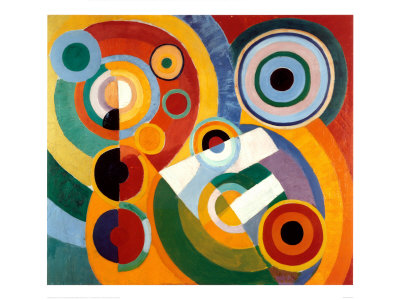
Rhythm, Joie de Vivre, by Robert Delaunay

Rhythm, Joie de Vivre, by Robert Delaunay

Huzzah for Shakespeare!

the audience for Edward III, the final play

the audience for Edward III, the final play

I got to be there! (See the upper right corner, balcony)

The Atlanta Shakespeare Company of the New American Shakespeare Tavern performed all 39 plays authored by William Shakespeare. Bravo!!

There is something special about the iconic status of William Shakespeare. Each time I see a play—even the lesser know, lesser praised—I am astonished at Shakespeare’s straightforward perusal of the human heart. It doesn’t surprise me that he ranks up near the Bible as far as most read, most translated, most published book in history.

Edward III is certainly not the most scintillating Shakespearean history, but it relentless drove home the age-old turmoil of duty to society and commitment to moral (even Divine) code. Who has precedence: the king who rules by divine right or the husband who pledges his troth? In a compelling (albeit didactic) series of scenes between the King, the Countess, and her father, we see all angles of this dilemma as they debate the Countess’ acquiescence to be the King’s mistress. (Pardon my unwieldy sentence.)

This theme reemerges in no less than five succeeding scenes throughout the play. Definitely heavy-handed, definitely well-perceived. These conflicts have a way of manifesting in countless areas of life’s routine. The struggle of human-constructed mores to cope with the vicissitudes of human relations never diminishes. No matter how many laws we right to correct each wrong, no matter how many initiatives we launch to inspire the masses, and no matter how many philosophical arguments are levied against ignorance, the problem of managing man’s soul remains.

To whom are we called to be whole-heartedly loyal? To whom do we finally answer? If to ourselves, we are hopelessly poor judges. If to Another, Who is He? How do we know Him?

I am proud of the work the ASC does: bringing the articulation of the human heart to the stage. Keeping the original text, performed by people you know, before a wide audience allows that audience to engage with the material, unburdened by another’s interpretation. The guidance of the director and the execution of the company becomes a playful yet meaningful conversation about life in which the audience still has a voice. Thank you, ASC, for valuing the work of art between author, text, and reader.

Sharktopus vs. Tales of Earthsea

Tales of Earthsesa: a glorious prospect

Tales of Earthsesa: a glorious prospect

Earthsea is a land far away filled with dragons that fight each other for little reason and magicians who gradually lose their power as the plot thickens.  Sharktopus is a rampaging hybrid quite proud of his body count and not afraid to show it.

I was super excited to watch Tales of Earthsea, for, yes, I blindly jump into any movie associated with the great name Miyazaki.  I was also super excited to watch Sharktopus with my brother and his fiancee on this rainy afternoon.  What else makes your day besides shamelessly sexy beach cutaways, gory deaths, and cheeto-cheesey dialog?

Tales of Earthsea opens with a promising back story—-slightly reminiscent of Laputa in Castle in the Sky. A glory quasi-ancient civilization is threatened by a disturbance in the balance between man and nature, darkness and light, war and peace.  Enter psycho-patricidal young prince, scarred-yet-stunning mysterious young girl, and a wizened-yet-waning wizard.  And, yes, as my clumsy adjective phrases may insinuate, these characters have all the right makings and none of the unique energy that makes animated characters glorious.  The best character was the creep sauce villain; how does William Dafoe make a whisper the most intimidating sound you’ve ever heard?

Where are we going in Earthsea?

Where are we going in Earthsea?

The artwork was beautiful—rich and organic, with just the right proportion of detail and simplicity.  It reminded me a bit of Cezanne’s contemplation of the mountain: simplifying and heightening the saturation of our real world actually helps us sense it in a more profound measure.  Like honey in tea is sweeter than honey in a spoon.

The character and plot development was woefully didactic.  Live vs. death.  Simple, straightforward, compelling. Somehow, those themes transformed into an essay on the cyclical, dualistic nature of reality.  To deny death is to deny life—-I think each character said that at least three times.  While I respect trying to grapple with intriguing concepts, a movie is still a movie.

That’s why Sharktopus wins this throw-down: it gave me exactly what I expected with pleasant variations.  I looked to Tales of Earthsea for a lyrical, almost pastoral, benediction and got a jumbled collection of aphorisms. I looked to Sharktopus for blood, sex, violence, and schlock and got blood, violence, schlock, and self-reflective sexiness.

Sharktopus pones a yacht.

Sharktopus pones a yacht.

My favorite moment in Sharktopus is the demise of a yacht-bound radio host.  Captain Jack has been exiled to Mexico by the FCC, where he is now assisted by a lovely Paris Hilton blond in a bikini as he provides witty, self-conscious commentary on the life he now leads—–whose exigence, of course, is Sharktopus itself.  As her Blackberry chirps the iPhone text tone (a lovely, homage-like goof), she reads to him an alert for attacks along the coastlines.  She is genuinely concerned; he goes on air and say the only way to stop the beast is virgin sacrifices.  Please email photos, preferably nude, to Captain Jack.  Off-air, he defends himself to his pouting assistant by saying there is no such thing as a sharktopus: whereupon he is promptly eaten alive by said creature.

Of course we know sharktopi don’t exist.  Of course we know life isn’t as simple as a dramatic script.  But that doesn’t mean we aren’t willing to suspend disbelief for 90 minutes and explore the possibilities.

Master Strategy (1)

Yes, I’m going to be the cheesy person who relates to you, my helpless reader, all the wonderful new things I’m learning in class.

I assume though that my winning voice will keep you captivated, of course.

This week I started a course called (and I quote): “The Master Strategies of Superachievers.”  And who doesn’t want to be a superachiever?  Duh! Everyone wants to be one! (Assumption #1).  But, no, really, this class is pretty cool.  It’s supposed to correct the fact that our educational system doesn’t prepare us for real life by teaching us 15 master strategies that will take us from being “drifters” to “superachievers”—those people that are worth writing books about.

I got involved because I realized there is a deplorable lack of mentorship built into the current relationship between new grads and their employers.  Of course I’m young and inexperienced!  I just graduated, genius! (Pardon my outburst.) So, this class is my effort to surround myself with some other folks in the business and art world who are determined to up the ante.  So, here you go:

Master Strategy (1): Discover which type of personality you have.  Play to your strengths, and your weaknesses will be empowered as you go along.  Learn the personalities of those around you, and partner with people whose strengths compensate for your weaknesses.

We are only part of the way through the various personalities, but a quick 10-question test can determine where you fall in the helpful metaphors: lion, otter, golden retriever, and beaver.  Side note, although possibly the most important thing I discovered: these metaphors are conceits!  For those of you not in the loop, a conceit is a complicated, sustained metaphor used to make an argument.  And I think the name usually fits well—-many authors are incurably attached to certain metaphors and in their conceit, they believe those metaphors are the best, most accessible means of explaining their point—regardless of the audience.  Anyway, the Lion personality is nothing like a real lion.  Ditto for the Otter, Golden Retriever, and Beaver.  The personalities are, however, very like our cultural constructions of a lion, an otter, a golden retriever, and a beaver.  So, I permit their use as an exercise in cultural semiology, long may it live.

Here’s the Lion:

  • decisive
  • aggressive
  • take-charge
  • natural leader
  • impatient
  • results-oriented
  • easily bored
  • glad of a challenge / variety

What do you think?

LION

LION

OTTER

OTTER

GOLDEN RETRIEVER

GOLDEN RETRIEVER

BEAVER

BEAVER