Archive for the ‘ film ’ Category

The False Adjustments We Make

I’m very fond of saying that everything in life is a choice.  And The Adjustment Bureau played out in real dialog for the first time.  My favorite part?  It exposed all the false dilemmas by which we cheat ourselves out of all that we can be.

***spoiler alert***

love the cant---the tension of who we are and who we see ourselves becoming

love the cant---the tension of who we are and who we see ourselves becoming

David Norris loves Elise Sellas.  He wants nothing more than to have her next to him for the rest of his life.  He doesn’t care about his career—although he does a damn good job of furthering it, despite his weaknesses.  He cares a hell of a lot about her career—and it nearly costs them the most important thing: to learn to love and be loved in return.

The Adjustment Bureau has decided that David and Elise shouldn’t be together.  That’s it.  At one point they were supposed to be together.  And now, they’re not.  Sucks for them that there is residual attraction.  The management of this bureau succinctly explains to David that to be all that each of them are capable of being—President of the United States and world-renowned choreographer—they must consent to life without each other.  Life incomplete, full of a void that can never be filled.  A void that the script implies was created precisely because the ravenous hunger it engenders was the only force powerful enough to propel them to their full potential.

But what The Adjustment Bureau does not allow for is the possibility of being happy teaching ballet to six year olds.  The possibility of being happy alone and not in front of a nation.  Like the Jane Austen critics that I pick a bone with, The Adjustment Bureau mistakes silence for voicelessness, privacy for emptiness, and security for imprisonment.  Elizabeth Bennett’s voice did not disappear at the end of Pride and Prejudice because Darcy locked her away in Pemberley  as his wife; her voice disappeared because she finally had an ear that was fully given to her whisper.  And David and Elise did not loose out on the greatest part of their story because they fought for their love; they actually wrote the most glorious story imaginable because they fought for their love.

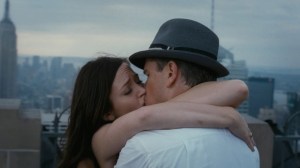
probably the best reaction ever: surrounded by men who want to kill you? kiss the one you love!

probably the best reaction ever: surrounded by men who want to kill you? kiss the one you love!

Whatever The Adjustment Bureau may be saying about Yhwh, Deism, Armenianism, or Calvinism doesn’t really interest me as much as what it says about humanism: humanity is worth fighting for.  All the reasoning of the Enlightenment and the mechanics of the Scientific and Industrial Revolutions cannot hold a candle to the ingenuity and fire of the human spirit in love.

It Can Be a Fair Game

where will we go from here?

where will we go from here?

At the end of Fair Game, Joe Wilson (Sean Penn) asks a straightforward question: How many of you know the 16 words in President Bush’s speech that led us to war in Iraq? No hands. How many of you know my wife’s name? All hands.

Valerie Plame—the beautiful CIA agent outed by the White House. The 2010 film recounting her story surprised me. What I expected to be an entirely political and propagandistic journey through a news story I vaguely remembered was actually a personal and inspiring interaction with my own Americanness. Valerie Plame’s life may have become fair game in the swirl of government and global relations, but there is hope for this generation to shirk off the embarrassment of American imperialism and participate in the fair game democracy can truly be at its best.

Yes, that was a rather sweeping statement, haha, but I think the film makes a strong case for participation in our government—or at least in the amplification of one’s voice that coalesces with other voices to make a government. And it pulled down grandiose abstracts—Freedom, Duty, Responsibility, Intelligence, and Patriotism—onto the intimate stage of interpersonal life.

where the world happens

where the world happens

Director Doug Liman expertly employed mise-en-scene to contextualize the American ideals in the American reality: the kids running through the kitchen, the dinner pot boiling on the stove, the patient hurrying out of the clinic, the lunchtime rush at a downtown restaurant, the babysitter coming and going, the cold hardwood floor at 3:45 a.m. You could listen to the dialog with your eyes closed and you would find an intriguing debate about the individual versus her government, but you wouldn’t really hear what the film is saying. You have to see it.

With each cut into action, each audio linkage, each carefully mixed ambient track, each fleeting glimpse of a ponytail, each just-out-frame introduction we begin to feel Valerie Plame’s life. Her life. No nation exists independently of the lives of its citizens. Whether they have a voice or are drowned out by power-mongering, those citizens are in fact that country. And this is what Fair Game reminds us.

Each person in the CIA is a normal person trying to be a loyal employee who is good at their job. (A generalization, yes, but one worth making because it is mostly true.) The more challenging implication is that people in power—such as Presidents—have just as much chance of being normal people making the best decisions they can to keep things moving forward as the CIA analyst. And the housewife. And the elementary school student. Life is damn hard, and making it through is a game of luck in which you collect as much information as you can and make the decision that is needed to move forward. Without forward motion, we die.

3:45 a.m.

3:45 a.m.

Now, that does not mean that Fair Game excuses the White House for what happened, for everything from the Iraqi War to the leak of “Valerie Plame.” It goes beyond mere smearing and challenges every citizen to hold its government accountable—to embrace the reality that we the people can make it a fair game once more. And the most beautiful scene is the one that reinforces that accountability and courage starts between two people: Valerie Plame comes back and refuses to let the fiasco steal her marriage to Joe Wilson. Making a name for ourselves within a marriage, keeping the word we have declared at the altar, takes more courage than managing secret covert operations for an employer that hasn’t pledged its allegiance to you.

I will acknowledge that this interpretation of Fair Game was deliciously influenced by screening Invictus earlier in the day. It is entirely opposite: Nelson Mandela has left his family to become the father of a nation. He has become the captain of his soul and taken the lowest road to greatness. Throughout the film, opposition accuses of him of being a self-promoting, distracted politician, and yet it showcases the depth of his leadership time and again. There were moments that reminded me of that glorious line in Batman Begins: if they need someone to chase, the people can chase me for a while. Batman allows the populace to think meanly of him when he is the only reason they have survived. Not because he has an inferiority complex, but because he is willing to absorb the high cost of change for a better world into his own person. That’s what Mandela did.

Invictus: politics is personal

Invictus: politics is personal

And he knew the power of inspiration. That’s why, the film tells us, he committed to the success of South African rugby. Just like Fair Game, Invictus understood that global realities actually form at the basic level of human experience: falling in love, having children, watching sports on TV, playing in the backyard, getting up in the morning, fixing dinner, having tea at 4 p.m. We have the power to change our world not merely because of the new channels of amplification—BBC, CNN, FOX, blogs, television, satellite broadcasts, YouTube, cell phones, high-tech communications—but simply because our world—food, shelter, warmth, clothing, love—is the world.

No, we cannot fully understand everyone else’s experience and it is fatal to assume that we can, but each person is in fact a human. And that makes all the difference.

Sometimes Wearing Shoes Helps You Find Your Way

the most beautiful filmic fairy tale

the most beautiful filmic fairy tale

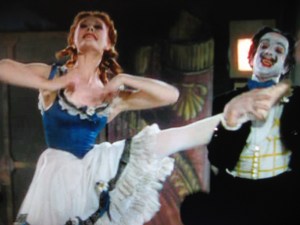
The Red Shoes is quite possibly the most stunning surprise I’ve seen in months.  The exquisite cinematography kept me glued to my iPhone screen for the whole two and a half hours.  Yes, I did it the disservice of watching it on my iPhone, curled up in bed.  But I must say, that The Red Shoes ran away with my soul and will not come back.  I’ll be purchasing it on Blu-ray and sitting spell-bound in my theater room for years to come.

If you’d like to read an informative summary and review, I refer you to Roger Ebert.  But really you ought to simply purchase the film and experience it all by yourself.  It reminded me of why I like to read fairy tales and will continue to read them until I lay upon my death bed—and even then, provided there’s time between the lying down and the dying.

Fairy tales help us travel this difficult world by simplifying it for us: we can recite all the characters by rote—the hero, the villain, the damsel in distress, the comic relief, the love triangle, the wicked relation.  But just because we recognize them doesn’t mean we really know them yet, and throughout the reading, the archetypes becomes sign posts on the journey to understanding.

Fairy tales help us by elevating our world from the mundane to the magnificent.  Death can look utterly wonderful at the final curtain.  The tedious repetition of our decisions is compressed into dramatic climaxes—rising and falling action, twists and turns.  In a fairy tale, your decision stands and you move forward; there is no washing back and forth on the tossing deck of the ship.  Every moment is fatal—and therefore more worth the living.

The Red Shoes may at first appear to be a classic fairy tale about two loves—the older and the younger, the promising and the seasoned.  But really it ends up being a most unique fairy tale: about the two halves of life, the one of work and the one of the heart.  As it is about artists, the parable of the red shoes can demonstrate oh! so painfully how hazy is the devision between the two, work and heart.  You cannot do one without the other: to work you must care and to care you must actualize through activity.  But there is such a desire to be wholehearted that the division in which we live grows into an impassable schism—especially if you are a woman.

trying so hard to make everything work---but your feet are pinned to the charade

trying so hard to make everything work---but your feet are pinned to the charade

To put food on your table, clothes on your body, and a roof over your head, you must perform a certain amount of utility for the world.  You earn your place in it.  But, to perform a certain amount of utility for the world usually plays out as a sacrifice of the dearest things you love: the person eating dinner with you, complimenting your dress, and waking up in your bed.  Our modern economy and  mode of living is predicated on specialization.  That specialization demands isolation of unique skills, repetition of their performative utility, and exclusive positioning in a system of production.

Sound anything like a ballerina performing the reparatory of her company?

We think that the arts are our last bulwark of everything human—that which is cooperative, creative, and mutual—and yet, in The Red Shoes we discover that not even the arts are safe from the pressures of post-industrial mechanism.  And I, lonely though “I” may be, am not willing to give them over without a fight.  Thanks to The Red Shoes, I discovered I was marching down a road I did not choose to a beat I have not written.  Now that I know that, I can turn and run.

http://www.youtube.com/watch?v=10_OAf05RcE&feature=related

Confusion in Paris

Confusion in Paris

Confusion in Paris

When my friend responded to “Let’s watch An American in Paris!” with “I think I’ve seen that before…I didn’t understand the ending…” I should have been forewarned.

But alas! I have committed to watching all the Best Picture Winners this summer (if possible), and 1951 has undone me.  How in the world did it beat A Streetcar Named Desire?!  I will concede that simply reading the list of winners makes me depressed—thanks to all the intense and “refined” and serious subject matter—and I, for one, appreciate a lively Minnelli musical, but, really?  My only conclusion must be that Freed and his unit hit the nail on the head: an American in Paris is confusing.

The opening voice-overs were promising enough, with witty and cynical characterizations of stereotypical Americans living in Paris.  Gene Kelly was wickedly interesting in his straightforward two-timing role, and Leslie Caron was, well, a French gamine.  (Although I would argue that no one deserves that title more than Audrey Hepburn herself, haha).  The parallels between the patronizing wealthy artist–I mean art collector and the romancing French night club singer were intriguing to about the degree that any conventional juxtaposition is.  Then the ending fell flat on its face.  Too tired of trying to be smart, it drowned itself in champagne bubbles and LSD whirlygigs until it actually believed its own schmaltz.

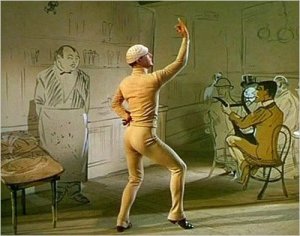
The one arresting development of the film–besides the hideous headpieces in “Stairway to Paradise”–was the homoerotic subtext.  Almost every love song was actually between two men about some far-distance female figure, whose role as the recipient of the romancing was hilariously adopted by whichever male the blocking conveniently provided for the pose.  The most salient of these moments is Gene Kelly cheek-to-cheek with Georges Geutary, waltzing and dipping through a cafe with a red-checkered tablecloth for a kerchief and a sappy grin as his token of feminine charm.  The film is about men in love, really, and they sort through their confusion all by themselves.  The women come and go as archetypal figures in the male story of navigating the most romantic city in the world.  The American in Paris could almost represent the male in America: expected to perform the rites of affection and affectation in an uncanny dance with the opposite sex, he literally leaps through hoops and fountains and promenades to win our hearts.

Gender performance, anyone?

Gender performance, anyone?

But really, don’t we all simply want simplicity?  Not an American in Paris–a tantalizing and confusing swirl of emotion and cross-cultural (dare I say cross-gender?) performance–but an American in America and a Parisian in Paris: at home with himself, his affections, and his relationships.

12 frames is all it takes

I’m incessantly puzzling over how to depict the exploitation of women without actually re-exploiting them “for the cause.”  How truly does an overly sexualized teenager staring vulnerably into the camera challenge our myths and presuppositions about trafficking in children?  Or how do eroticized action films confront our fantasies and pigeon-hole estimations of femininity?  And then, how do you actually create images of exploitative situations without exploiting the [child] actors involved?

It’s a theme I’ve been contemplating for years now, and my thoughts are in such constant flux and evaluation that I rarely get to actually put “pen to paper” about it.  But today I watched The Click Five and MTV Exit’s new music video for their song “Don’t Let Me Go” and in a flash of brilliance at least one rhetorical construct made sense: twelve frames is all it takes.

Between 2:54 and 2:55 there is a grainy black-and-white flash that says everything: a man pins down and straddles a young girl on a stark white mattress.  The high angle and visual quality of the shot evoke those creepy, voyeuristic hotel security cameras.  Suddenly, in perhaps 12 frames or less, we the viewer are skyrocketed into the bird’s eye view, the simple, clear, gray-scale truth that children are being hurt at the hands of adults who are supposed to protect them.

And it hit my gut.  A four-minute video with pretty tame, allegorical representations of trafficking—and one freezing moment, blink and its gone but forever imprinted on your soul.  For all the complex planning and production and analysis that litters the table of abolition rhetoric, twelve frames was all it took.

Arrested Development (1)

Somehow I missed one of the greatest shows EVER until this week: I just discovered Arrested Development (thanks to my super-brilliant friends who knew it was a match made in heaven).

http://www.youtube.com/watch?v=LBWZdYVeMjw

Not only do I love Jason Bateman (please please at least see Juno and Mr. Magorium’s Wonder Emporium) but I love TV that asks us to take a good long look at ourselves, individually and corporately.  Implied in the long look is the need for action—some kind of decisive maneuver that either confirms, denies, or changes what we see.

Perhaps it’s too simplistic to look at the Bluth family as a representation of America itself.  I’m sure hundreds of other critics who happily discovered this show before I did have made the correlation.  But as the saying goes, there’s a reason that cliches become cliches.  So, bear with me as I assert  that the Bluth family is in some respect America itself.  Broken, dysfunctional, wealthy, lacking integrity, confused, passionate, maybe even philanthropic at turns—-but basically, it’s a family.  Family is not the kind of thing that you can choose to be a part of, but it does have the “opt in” / “opt out” selection at the bottom of the form.  The world itself conspires to set you in the damn thing: whether it’s the biology that makes you happen because of your parents; whether it’s the complex social psychology that makes you a part of a group that comes together and stays together to help each of its members make its way in the world; or whether it’s the deeply spiritual transaction that suddenly binds you to everyone else on the planet that’s as crazy as you.  You don’t “pick” your family but you decide to participate.

Michael Bluth: Remind me why I'm doing this?

Michael Bluth: Remind me why I'm doing this?

Michael Bluth decides to participate.  And that single action makes him a hero.  In a larger sense, those of us that decide to participate in this (ready for another worn out cliche?) melting pot country are heroes.  Nothing about America should work; but it does.  Limpingly, grotesquely, obliquely, embarrassingly, it does.  The Bluth family survives crisis although we’d really all prefer to see them degraded a bit—but not really, because, of course, there’s a lot a bit of ourselves staring back at us.  The American “family” survives crisis although we’d really all prefer to see us cut down to size a bit—but not really because, of course, we are America.  Maybe that’s what’s so damn heroic about MIchael Bluth: he humbly decides to participate in something that’s obviously a poor reflection on himself for the benefit of all the other people caught up in the mess.

Disclaimer: I’ve only seen three episodes.  My opinions are subject to wild and inconsistent changes—-though I usually pick one interpretation and stick with it.

$ensorship

the MPAA avatar

the MPAA avatar

oyster and pearl

oyster and pearl

The rating system of the Motion Pictures Association of America is far above us. They have discovered the ultimate avatar: the Normal American Parent. Under the guise of this avatar, they crop and edit and cut their way through the discourse of the nation to ensure happy, healthy citizens of us all.


Yes, the MPAA shows up on every preview.

Yes, the MPAA shows up on every preview.

This is the bleak (albeit accurate) view of the MPAA and its role in our film culture presented in This Film is Not Yet Rated. Every film that makes it to theatrical audiences must run the gamut of secret voting procedures, obscure objections, blind cuts, and precedent-less appeals. No other organization in the United States (barring our inestimable CIA) could skip away with such egregious power-mongering. While watching it, I became extremely jealous and proud of my college education, in which professors broke through the money-making studio system to bring me films that challenged my perspectives on life, the Universe, and everything. And, while I sat and pondered the truth that money really does make the world go ’round, the world go ’round, and that if there’s money, someone has to stick their hand in it to control the current, I also became increasingly bewildered at the underlying tug-of-war between the Faith and Knowledge.


Faith and Knowledge---Life or Death?

Faith and Knowledge---Life or Death?

You see, two clergymen serve on the appeals board of the MPAA film ratings committee. Whether voting members of passive observers (even former committee members couldn’t tell which), their presence harkens back to the long struggle in the church (and America, as a larger encasement of said Church) over the issue of discourse. Should everyone have access to all the knowledge they want?—If yes, ’tis a ‘yes’ sprung from the glorious expectation that knowledge contains powers of improvement [that counterbalance any powers of detriment therein]. Should money determine access to knowledge?—If yes, ’tis a ‘yes’ based on the tired assumption that if you have money, you must have had sense enough to earn it and are therefore able to make good decisions [about your soul]. Should no one have access to all knowledge?—If yes, ’tis a ‘yes’ based on the dismal assumption that knowledge corrupts [just as the absolute power that comes along with it].

Do I choose my tree?

Do I choose my tree?

Does it really all come down to whether you want to be a glorious, tired, or dismal person? I would like to think that somewhere even deeper than the surface eddies of Money and the tugging tides of Faith and Knowledge there is a priceless pearl hidden: Truth. I say ‘pearl,’ of course, intentionally because it never fails to be a profound metaphor: irritation initiating a response that ultimately yields a beautiful, organic unit of Beauty. Perhaps the MPAA is the grain of sand that, for better or worse, will never be ejected from America’s oyster, and maybe we’ll find the Truth about who we are as people, filmmakers, audiences, and parents from the constant reaction to each asinine rating.

Sharktopus vs. Tales of Earthsea

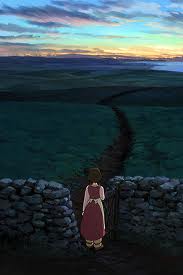
Tales of Earthsesa: a glorious prospect

Tales of Earthsesa: a glorious prospect

Earthsea is a land far away filled with dragons that fight each other for little reason and magicians who gradually lose their power as the plot thickens.  Sharktopus is a rampaging hybrid quite proud of his body count and not afraid to show it.

I was super excited to watch Tales of Earthsea, for, yes, I blindly jump into any movie associated with the great name Miyazaki.  I was also super excited to watch Sharktopus with my brother and his fiancee on this rainy afternoon.  What else makes your day besides shamelessly sexy beach cutaways, gory deaths, and cheeto-cheesey dialog?

Tales of Earthsea opens with a promising back story—-slightly reminiscent of Laputa in Castle in the Sky. A glory quasi-ancient civilization is threatened by a disturbance in the balance between man and nature, darkness and light, war and peace.  Enter psycho-patricidal young prince, scarred-yet-stunning mysterious young girl, and a wizened-yet-waning wizard.  And, yes, as my clumsy adjective phrases may insinuate, these characters have all the right makings and none of the unique energy that makes animated characters glorious.  The best character was the creep sauce villain; how does William Dafoe make a whisper the most intimidating sound you’ve ever heard?

Where are we going in Earthsea?

Where are we going in Earthsea?

The artwork was beautiful—rich and organic, with just the right proportion of detail and simplicity.  It reminded me a bit of Cezanne’s contemplation of the mountain: simplifying and heightening the saturation of our real world actually helps us sense it in a more profound measure.  Like honey in tea is sweeter than honey in a spoon.

The character and plot development was woefully didactic.  Live vs. death.  Simple, straightforward, compelling. Somehow, those themes transformed into an essay on the cyclical, dualistic nature of reality.  To deny death is to deny life—-I think each character said that at least three times.  While I respect trying to grapple with intriguing concepts, a movie is still a movie.

That’s why Sharktopus wins this throw-down: it gave me exactly what I expected with pleasant variations.  I looked to Tales of Earthsea for a lyrical, almost pastoral, benediction and got a jumbled collection of aphorisms. I looked to Sharktopus for blood, sex, violence, and schlock and got blood, violence, schlock, and self-reflective sexiness.

Sharktopus pones a yacht.

Sharktopus pones a yacht.

My favorite moment in Sharktopus is the demise of a yacht-bound radio host.  Captain Jack has been exiled to Mexico by the FCC, where he is now assisted by a lovely Paris Hilton blond in a bikini as he provides witty, self-conscious commentary on the life he now leads—–whose exigence, of course, is Sharktopus itself.  As her Blackberry chirps the iPhone text tone (a lovely, homage-like goof), she reads to him an alert for attacks along the coastlines.  She is genuinely concerned; he goes on air and say the only way to stop the beast is virgin sacrifices.  Please email photos, preferably nude, to Captain Jack.  Off-air, he defends himself to his pouting assistant by saying there is no such thing as a sharktopus: whereupon he is promptly eaten alive by said creature.

Of course we know sharktopi don’t exist.  Of course we know life isn’t as simple as a dramatic script.  But that doesn’t mean we aren’t willing to suspend disbelief for 90 minutes and explore the possibilities.

Job Application (1)

I understand where he’s coming from, my dad.  His job has been to provide for me and train me in the ways of self-preservation.  Not cheap psychological coping mechanisms, but the preservation of my body, soul, and spirit by the earning of money and applying of money to material needs.  Seeing his brilliant, confusing liberal arts daughter (he’s an engineer), move back into his generous home after earning a degree at a top university must have been a bit of a shock.

Don’t get me wrong: he likes having me home.  I order Chinese for everyone on Friday nights.  But apart from the pleasure of my company, I’m sure he’s a little nervous to see me coming and going through his back door still.  He’s taken to asking: “What jobs have you applied for lately?”

We won’t mention that I currently hold two “part-time” jobs that require full-time hours (i.e. I’m in management in both).

But today I applied for a job, one that I hope I will get and be glad to have gotten.  I’d like to be an editor one day (I tell myself in my moments of grandeur).  A connection I wisely cultivated sent me the call for applications she’d received from her lofty position as a paid filmmaker.  I have this habit of signing onto my email account five minutes after she sends these types of emails, leaving me wondering if the great Cosmos and His sidekick have made a delicious pass at my faith.  I submitted my new resume before the next (fateful) five minutes had passed.

how my heart hangs in the balance

how my heart hangs in the balance

The climax of this rising action remains to be seen, but be assured, dear reader, you shall know all in due time.

Screening for the ATLFF

A friendly email invited me to apply for membership in the panel of screeners for the upcoming Atlanta Film Festival.  With innocent and smiling eyes I filled out the form and turned it in–hoping to make it, not sure what I was doing, but feeling cool every second of the process.

A friendly email notified me that I was in fact accepted into this circle of evaluators and would I please join a conference call next week?

Of course!

Now, I begin my journey through 90 films in 15 weeks, hallelujah.

I wish I could write about these films–the ones that grab my insides and squeeze, the ones that tickle me pink, the ones that leave me, just leave me.  But, alas, the beautiful privilege of screening denies me company in this adventure.  It makes me wonder what Someone must feel like Who knows and sees everything, the exquisite and the unlovely, and holds it all in silence.

Suspended in Silence

Suspended in Silence

Silence.

Silence.

Silence.

Pregnant silence.  The kind of silence that must fill the earth when sees germinate in the spring.  The kind of silence that whitewashes elephant bones.  The kind of silence that makes you want to seek other out but finds that no bridge could span its borders…

The truth, perhaps.